
Universal Li-Ion battery packs for underwater applications
We offer you a unique program to provide universal battery packs applicable to most of the flashlights and heating systems in use for divers.
The design of the packs, was conceived to provide the largest possible total battery capacity with the smallest possible external dimensions. For each pack, the optimal arrangement of internal components was used, which often allows the use of a battery with a higher capacity than the factory one in the existing housing.
We use only the highest quality cells in the production of packages. Each is individually tested before installation, and the entire, finished package is re-tested. For more information: > How we produce our packages.
Here is a quick guide on how to choose the right package for your device:
- Battery type
Li-Ion (lithium-ion) batteries are mainly used in diving applications today. Our universal packages are made with this technology. Older devices also used Ni-Mh (nickel-metal hydride) or the oldest type Ni-Cd (nickel-cadmium) batteries, and less frequently (Pb) lead acid batteries . Unless we know what battery is used in our device it is essential to determine this. If the battery canister is easily disassembled, the type information should be on the sticker, on the package. Such information should also be included in the instruction manual. If you have trouble finding the marking, it’s a good idea to look at the charger carefully. Often it is marked on it which batteries it is designed for.
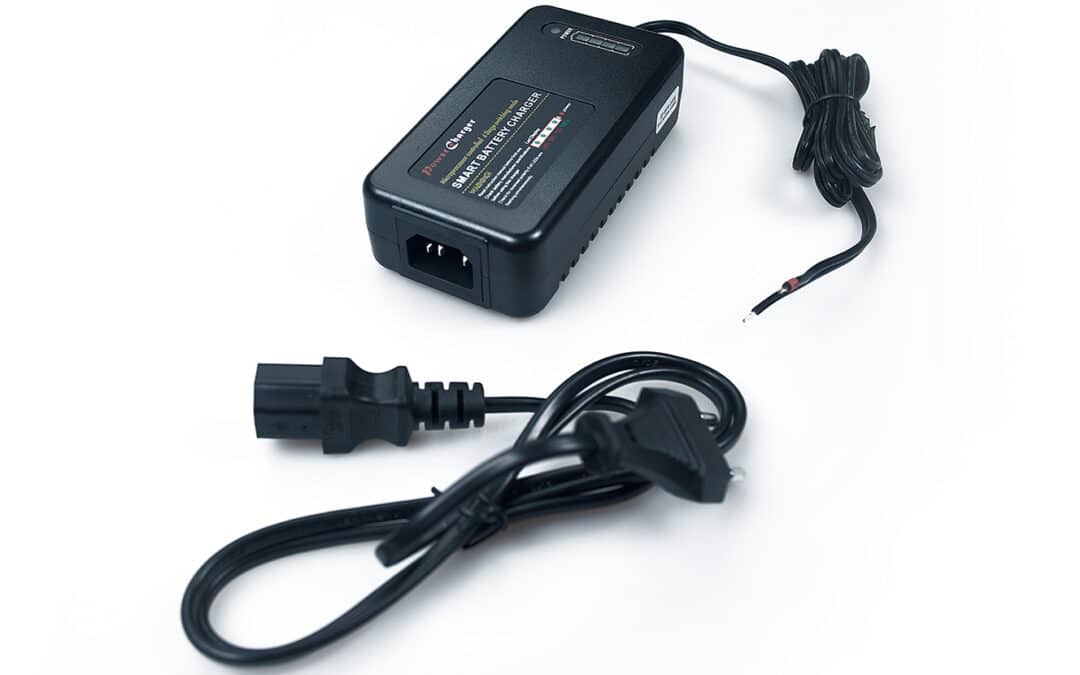
If it turns out that there are Li-Ion (lithium-ion) batteries in our device, the matter is very simple. Just check what voltage they are configured for. You will read about it below – see Operating voltage. If you originally used batteries of a different type, you can still use our universal Li-Ion (lithium-ion) pack, but you will need to replace the charger. Chargers for our packages, you can find here . An additional benefit in such a case will be a much longer operating time of the device. Li-Ion (lithium-ion) batteries offer much greater capacity for the same size. However, if the type of the original battery could not be determined, please contact us. We will try to determine it from the photos, and if it is impossible, ask you to send the package to us, then we will choose the best solution for you.
- Operating voltage
Li-Ion (lithium-ion) batteries – the most common voltage rating for Li-Ion (lithium-ion) batteries is 14.8V. Packages with this voltage are designated as 4S. This means connecting four cells in series 4S=4×3.7V=14.8V. Of course, this is the rated voltage and varies during battery operation. Immediately after charging is 16.8V, and when the battery is completely discharged, it drops below 12V. The value of 14.8V is the nominal value (most of the time the battery operates just at this voltage). The second voltage value used (often in heating systems) is 11.1V – denoted 3S (3×3.7V=11.1V). Such a package operates in the voltage range of 9.0-12.6V. It is very important to determine whether a 3S or 4S package was used. As with the type of pack, the easiest way to find this information is on the sticker, in the manual or on the charger. Direct voltage measurement with a voltmeter is possible, but only if the batteries are efficient enough to be charged, and we measure directly after charging. Otherwise there is a risk of making a mistake, a charged 3S battery may have a higher voltage than a discharged 4S battery!
Nickel Ni-Mh (nickel-metal hydride) or Ni-Cd (nickel-cadmium) batteries – if our device uses nickel Ni-Mh (nickel-metal hydride) or Ni-Cd (nickel-cadmium) batteries, we must choose the most similar voltage of the universal pack. Thus, for nominal voltages of 10.8-13.2V we recommend using a 3S pack, for voltages of 14.4-16.8V a 4S pack.
- How to mark connections inside the package
To get the right pack capacity and current capacity, the cells are connected in parallel before the batteries are connected in series (e.g. 3S, 4S). The number of cells connected in parallel is indicated by the “P” marking. For example, if we see the designation 3S2P, in our package connected in series, three sets consisting of two cells connected in parallel. What is important for the user is the voltage of the pack, which in this case is 3S – the operating voltage is 11.1V (3×3.7V=11.1V). Information about the number of cells connected in parallel (2P)-this is technical information, meaningless to the user.

Photo of package markings.
- Package dimensions
In order to determine what the largest battery will fit in our case it is necessary to disassemble it. After measuring the available space, knowing the predetermined battery voltage (3S or 4S), we can select the table of the largest battery we can install.

Determining the above three points is critical to the proper selection, and thus the safety of battery use. If you have any doubts, please contact us.
Construction and elements of packages
- BMS-what it is and what functions it has
- Principles of selecting a BMS for a battery pack
- Parallel connection of lithium batteries
- Charging battery packs
- Information on first use and storage of batteries