
Is it always a good idea to install the largest battery possible?
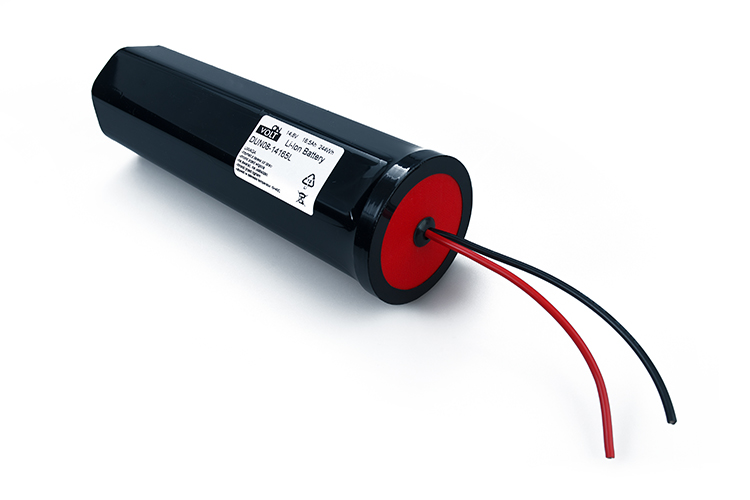
It depends on what we are going to power with it and what kind of dives we plan to make. With heating systems, using the largest battery will be a sensible choice. These systems consume a lot of energy, and even if you don’t fully discharge the battery during the dive, it will run at higher voltages for a longer period of time, resulting in better heating operation. Here we use a battery as large as possible.
When powering underwater lighting, it all depends on the type and power of the head. The most energy-intensive are lights with a halogen bulb, more energy-efficient are HID lamps, and the least energy is required by those made with LED technology. Of course, a very powerful LED video light, will need more power than a small flashlight even with a halogen bulb.
Knowing the power of our head, we can estimate the battery capacity needed.
In simplified terms, we can assume that for every hour of operation of a 10W head with a voltage of 14.4V (4S), we need 0.7Ah of battery capacity. At 11.1V (3S), this will be 0.9Ah per hour.
That is, for example, having a 30W head, which we want to ensure operation for 3 hours, we will need a battery with a capacity:
(30W/10W)*3h*0.7A = 6.3Ah
So much for theory, in practice we suggest using a battery that is larger by approx. 50%, due to the natural decrease in its capacity during use and the reduction in capacity if you use the battery at low temperatures. The right choice is approx. 10Ah.
Using a larger battery, of course, is possible, but it will come at the price of a higher price and weight.
Construction and elements of packages
- BMS-what it is and what functions it has
- Principles of selecting a BMS for a battery pack
- Parallel connection of lithium batteries
- Charging battery packs
- Information on first use and storage of batteries